Spring Boot MySQL Database Design with Flyway and JPA (Uptime Monitor Part 2)
Design the MySQL schema for a Spring Boot uptime monitor: Flyway migrations, indexes, JPA entities, auditing and optimistic locking. Part 2 of the UpCheck series.
Part 2 of the UpCheck series designs the MySQL schema: four tables created by a Flyway migration, the indexes that keep queries fast, and the JPA entities that map them.
- Part 1: Project setup with MySQL and Docker
- Part 2: Database design with Flyway and JPA (you are here)
- Part 3: REST API, validation and error handling
- Part 4: Spring Security with JWT
- Part 5: Scheduler with virtual threads
- Part 6: Incidents and email alerts
- Part 7: Uptime stats, pagination and retention
- Part 8: Testing, Docker and deployment
MySQL database design with Flyway and JPA entities#
Today you create four tables with a Flyway migration and map them to JPA entities. Good indexes now save you from slow dashboards later.
The four tables#
| Table | One row is | Grows by |
|---|---|---|
| users | an account | sign-ups |
| monitors | a URL to watch | user actions |
| check_results | one HTTP check | every check (largest table) |
| incidents | one period of downtime | each outage |
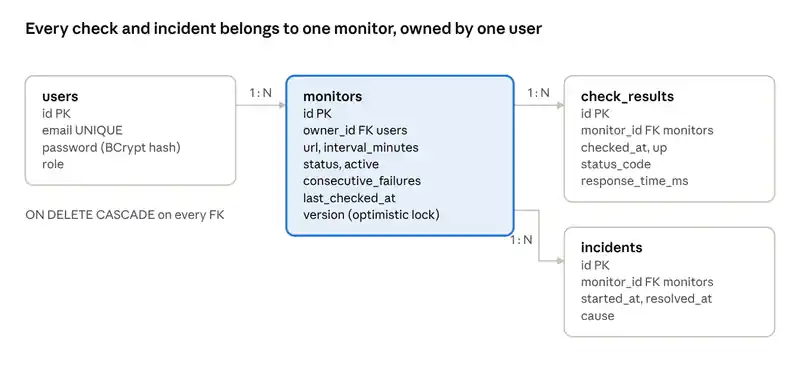
The monitors table is the hub: one user owns many monitors, and each monitor has many check results and incidents.
Why Flyway instead of ddl-auto=update?#
ddl-auto=update guesses schema changes and never drops or renames anything safely. Flyway runs versioned SQL files in order and records them in flyway_schema_history, so every environment gets the exact same schema. Never edit a migration after it has run; add V2__...sql instead.
Step 1: The migration#
-- src/main/resources/db/migration/V1__create_tables.sql
CREATE TABLE users (
    id          BIGINT AUTO_INCREMENT PRIMARY KEY,
    name        VARCHAR(100)  NOT NULL,
    email       VARCHAR(255)  NOT NULL,
    password    VARCHAR(100)  NOT NULL,
    role        VARCHAR(20)   NOT NULL DEFAULT 'USER',
    created_at  DATETIME(6)   NOT NULL,
    updated_at  DATETIME(6)   NOT NULL,
    CONSTRAINT uk_users_email UNIQUE (email)
);

CREATE TABLE monitors (
    id                    BIGINT AUTO_INCREMENT PRIMARY KEY,
    owner_id              BIGINT        NOT NULL,
    name                  VARCHAR(100)  NOT NULL,
    url                   VARCHAR(2048) NOT NULL,
    interval_minutes      INT           NOT NULL,
    active                BOOLEAN       NOT NULL DEFAULT TRUE,
    status                VARCHAR(10)   NOT NULL DEFAULT 'UNKNOWN',
    consecutive_failures  INT           NOT NULL DEFAULT 0,
    last_checked_at       DATETIME(6)   NULL,
    version               BIGINT        NOT NULL DEFAULT 0,
    created_at            DATETIME(6)   NOT NULL,
    updated_at            DATETIME(6)   NOT NULL,
    CONSTRAINT fk_monitors_owner FOREIGN KEY (owner_id) REFERENCES users (id) ON DELETE CASCADE,
    CONSTRAINT chk_monitors_interval CHECK (interval_minutes IN (1, 5, 15))
);
CREATE INDEX idx_monitors_due ON monitors (active, last_checked_at);
CREATE INDEX idx_monitors_owner ON monitors (owner_id);

CREATE TABLE check_results (
    id                BIGINT AUTO_INCREMENT PRIMARY KEY,
    monitor_id        BIGINT        NOT NULL,
    checked_at        DATETIME(6)   NOT NULL,
    up                BOOLEAN       NOT NULL,
    status_code       INT           NULL,
    response_time_ms  BIGINT        NULL,
    error_message     VARCHAR(500)  NULL,
    CONSTRAINT fk_checks_monitor FOREIGN KEY (monitor_id) REFERENCES monitors (id) ON DELETE CASCADE
);
CREATE INDEX idx_checks_monitor_time ON check_results (monitor_id, checked_at);
CREATE INDEX idx_checks_time ON check_results (checked_at);

CREATE TABLE incidents (
    id           BIGINT AUTO_INCREMENT PRIMARY KEY,
    monitor_id   BIGINT        NOT NULL,
    started_at   DATETIME(6)   NOT NULL,
    resolved_at  DATETIME(6)   NULL,
    cause        VARCHAR(500)  NULL,
    CONSTRAINT fk_incidents_monitor FOREIGN KEY (monitor_id) REFERENCES monitors (id) ON DELETE CASCADE
);
CREATE INDEX idx_incidents_monitor_open ON incidents (monitor_id, resolved_at);
Each index has one job:
idx_monitors_duelets the scheduler find due monitors without scanning the table.idx_checks_monitor_timepowers the history page and the uptime % query (monitor + time range).idx_checks_timemakes the nightly cleanup delete fast.ON DELETE CASCADEmeans deleting a monitor removes its checks and incidents in one SQL statement.
Step 2: A base class for id and audit columns#
package com.upcheck.common;

import jakarta.persistence.*;
import org.springframework.data.annotation.CreatedDate;
import org.springframework.data.annotation.LastModifiedDate;
import org.springframework.data.jpa.domain.support.AuditingEntityListener;

import java.time.Instant;

@MappedSuperclass
@EntityListeners(AuditingEntityListener.class)
public abstract class BaseEntity {

    @Id
    @GeneratedValue(strategy = GenerationType.IDENTITY)
    private Long id;

    @CreatedDate
    @Column(name = "created_at", nullable = false, updatable = false)
    private Instant createdAt;

    @LastModifiedDate
    @Column(name = "updated_at", nullable = false)
    private Instant updatedAt;

    public Long getId() { return id; }
    public Instant getCreatedAt() { return createdAt; }
    public Instant getUpdatedAt() { return updatedAt; }
}
Step 3: The User entity#
package com.upcheck.user;

import com.upcheck.common.BaseEntity;
import jakarta.persistence.*;

@Entity
@Table(name = "users")
public class User extends BaseEntity {

    @Column(nullable = false, length = 100)
    private String name;

    @Column(nullable = false, unique = true)
    private String email;

    @Column(nullable = false, length = 100)
    private String password;   // BCrypt hash, never the raw password

    @Enumerated(EnumType.STRING)
    @Column(nullable = false, length = 20)
    private Role role = Role.USER;

    protected User() {}  // for JPA

    public User(String name, String email, String passwordHash) {
        this.name = name;
        this.email = email;
        this.password = passwordHash;
    }

    public String getName() { return name; }
    public String getEmail() { return email; }
    public String getPassword() { return password; }
    public Role getRole() { return role; }

    public enum Role { USER, ADMIN }
}
package com.upcheck.user;

import org.springframework.data.jpa.repository.JpaRepository;
import java.util.Optional;

public interface UserRepository extends JpaRepository<User, Long> {
    Optional<User> findByEmail(String email);
    boolean existsByEmail(String email);
}
Step 4: The Monitor entity (with its business rule inside)#
The status logic lives in the entity, not in a service. That keeps the rule in one place and makes it trivial to unit test. Note @Version: it stops a user edit and a background check from silently overwriting each other.
package com.upcheck.monitor;

public enum MonitorStatus {
    UNKNOWN,   // never checked yet
    UP,
    DOWN
}
package com.upcheck.monitor;

import com.upcheck.common.BaseEntity;
import com.upcheck.user.User;
import jakarta.persistence.*;

import java.time.Instant;

@Entity
@Table(name = "monitors")
public class Monitor extends BaseEntity {

    @ManyToOne(fetch = FetchType.LAZY, optional = false)
    @JoinColumn(name = "owner_id", nullable = false)
    private User owner;

    @Column(nullable = false, length = 100)
    private String name;

    @Column(nullable = false, length = 2048)
    private String url;

    @Column(name = "interval_minutes", nullable = false)
    private int intervalMinutes;

    @Column(nullable = false)
    private boolean active = true;

    @Enumerated(EnumType.STRING)
    @Column(nullable = false, length = 10)
    private MonitorStatus status = MonitorStatus.UNKNOWN;

    @Column(name = "consecutive_failures", nullable = false)
    private int consecutiveFailures;

    @Column(name = "last_checked_at")
    private Instant lastCheckedAt;

    @Version
    private long version;

    protected Monitor() {}

    public Monitor(User owner, String name, String url, int intervalMinutes) {
        this.owner = owner;
        this.name = name;
        this.url = url;
        this.intervalMinutes = intervalMinutes;
    }

    public void update(String name, String url, int intervalMinutes, boolean active) {
        boolean urlChanged = !this.url.equals(url);
        this.name = name;
        this.url = url;
        this.intervalMinutes = intervalMinutes;
        this.active = active;
        if (urlChanged) {
            // check the new URL on the next poll; status stays as-is so an open
            // incident is closed (and a RECOVERED email sent) once the new URL is UP
            this.consecutiveFailures = 0;
            this.lastCheckedAt = null;
        }
    }

    /**
     * Applies one check result and returns the new status when it changed, else null.
     * A site is DOWN only after failureThreshold failures in a row,
     * so one slow response doesn't wake anyone up at 3 a.m.
     */
    public MonitorStatus recordCheck(boolean up, Instant checkedAt, int failureThreshold) {
        this.lastCheckedAt = checkedAt;
        MonitorStatus previous = this.status;

        if (up) {
            consecutiveFailures = 0;
            status = MonitorStatus.UP;
        } else {
            consecutiveFailures++;
            if (consecutiveFailures >= failureThreshold) {
                status = MonitorStatus.DOWN;
            }
        }
        return previous != status ? status : null;
    }

    public User getOwner() { return owner; }
    public String getName() { return name; }
    public String getUrl() { return url; }
    public int getIntervalMinutes() { return intervalMinutes; }
    public boolean isActive() { return active; }
    public MonitorStatus getStatus() { return status; }
    public int getConsecutiveFailures() { return consecutiveFailures; }
    public Instant getLastCheckedAt() { return lastCheckedAt; }
}
Step 5: CheckResult and Incident entities#
CheckOutcome is a plain record for the result of one HTTP call. The entity copies it when we save.
package com.upcheck.check;

import java.time.Instant;

public record CheckOutcome(boolean up, Integer statusCode, Long responseTimeMs,
                           String errorMessage, Instant checkedAt) {

    private static final int MAX_ERROR_LENGTH = 500;

    public static CheckOutcome success(int statusCode, long responseTimeMs, Instant at) {
        return new CheckOutcome(true, statusCode, responseTimeMs, null, at);
    }

    public static CheckOutcome httpFailure(int statusCode, long responseTimeMs, Instant at) {
        return new CheckOutcome(false, statusCode, responseTimeMs, "HTTP " + statusCode, at);
    }

    public static CheckOutcome error(String message, Long responseTimeMs, Instant at) {
        String safe = message == null ? "Unknown error" : message;
        if (safe.length() > MAX_ERROR_LENGTH) {
            safe = safe.substring(0, MAX_ERROR_LENGTH);
        }
        return new CheckOutcome(false, null, responseTimeMs, safe, at);
    }
}
package com.upcheck.check;

import com.upcheck.monitor.Monitor;
import jakarta.persistence.*;

import java.time.Instant;

/** One row per check. Append-only, so no audit columns. */
@Entity
@Table(name = "check_results")
public class CheckResult {

    @Id
    @GeneratedValue(strategy = GenerationType.IDENTITY)
    private Long id;

    @ManyToOne(fetch = FetchType.LAZY, optional = false)
    @JoinColumn(name = "monitor_id", nullable = false)
    private Monitor monitor;

    @Column(name = "checked_at", nullable = false)
    private Instant checkedAt;

    @Column(nullable = false)
    private boolean up;

    @Column(name = "status_code")
    private Integer statusCode;

    @Column(name = "response_time_ms")
    private Long responseTimeMs;

    @Column(name = "error_message", length = 500)
    private String errorMessage;

    protected CheckResult() {}

    public CheckResult(Monitor monitor, CheckOutcome outcome) {
        this.monitor = monitor;
        this.checkedAt = outcome.checkedAt();
        this.up = outcome.up();
        this.statusCode = outcome.statusCode();
        this.responseTimeMs = outcome.responseTimeMs();
        this.errorMessage = outcome.errorMessage();
    }

    public Long getId() { return id; }
    public Monitor getMonitor() { return monitor; }
    public Instant getCheckedAt() { return checkedAt; }
    public boolean isUp() { return up; }
    public Integer getStatusCode() { return statusCode; }
    public Long getResponseTimeMs() { return responseTimeMs; }
    public String getErrorMessage() { return errorMessage; }
}
package com.upcheck.incident;

import com.upcheck.monitor.Monitor;
import jakarta.persistence.*;

import java.time.Duration;
import java.time.Instant;

/** A period of downtime: opens when a monitor goes DOWN, closes when it is UP again. */
@Entity
@Table(name = "incidents")
public class Incident {

    @Id
    @GeneratedValue(strategy = GenerationType.IDENTITY)
    private Long id;

    @ManyToOne(fetch = FetchType.LAZY, optional = false)
    @JoinColumn(name = "monitor_id", nullable = false)
    private Monitor monitor;

    @Column(name = "started_at", nullable = false)
    private Instant startedAt;

    @Column(name = "resolved_at")
    private Instant resolvedAt;

    @Column(length = 500)
    private String cause;

    protected Incident() {}

    public Incident(Monitor monitor, Instant startedAt, String cause) {
        this.monitor = monitor;
        this.startedAt = startedAt;
        this.cause = cause;
    }

    public void resolve(Instant at) { this.resolvedAt = at; }

    public boolean isOpen() { return resolvedAt == null; }

    public Duration duration(Instant now) {
        return Duration.between(startedAt, resolvedAt != null ? resolvedAt : now);
    }

    public Long getId() { return id; }
    public Monitor getMonitor() { return monitor; }
    public Instant getStartedAt() { return startedAt; }
    public Instant getResolvedAt() { return resolvedAt; }
    public String getCause() { return cause; }
}
Restart the app. Flyway logs Successfully applied 1 migration, and Hibernate validates all four entities against the tables. If a column name or type does not match, startup fails with a clear message, which is exactly why validate is the safe choice.
Key takeaways#
- Flyway runs versioned SQL so every environment has the same schema; Hibernate only validates it.
- Design indexes for your real queries: due monitors, history by time and nightly cleanup.
- Put business rules like UP/DOWN transitions in the entity and guard it with @Version.