Email Alerts with Spring Events and @TransactionalEventListener (Uptime Monitor Part 6)
Send DOWN and RECOVERED emails from Spring Boot with incidents, Spring events, @Async and @TransactionalEventListener, without alert spam. Part 6 of the UpCheck series.
Part 6 of the UpCheck series emails you when a site goes DOWN and again when it RECOVERS, and records every outage as an incident.
- Part 1: Project setup with MySQL and Docker
- Part 2: Database design with Flyway and JPA
- Part 3: REST API, validation and error handling
- Part 4: Spring Security with JWT
- Part 5: Scheduler with virtual threads
- Part 6: Incidents and email alerts (you are here)
- Part 7: Uptime stats, pagination and retention
- Part 8: Testing, Docker and deployment
Incidents and email alerts with Spring events#
Today UpCheck emails you when a site goes DOWN and again when it RECOVERS, with the downtime. Each outage is saved as an incident so users can see their history.
The status rules#
| From | To | When | What happens |
|---|---|---|---|
| UNKNOWN | UP | first successful check | nothing (no alert for a new monitor) |
| UP | DOWN | 2 failures in a row (failure-threshold) |
open incident, send DOWN email |
| DOWN | DOWN | more failures | nothing (no spam) |
| DOWN | UP | one successful check | close incident, send RECOVERED email with downtime |
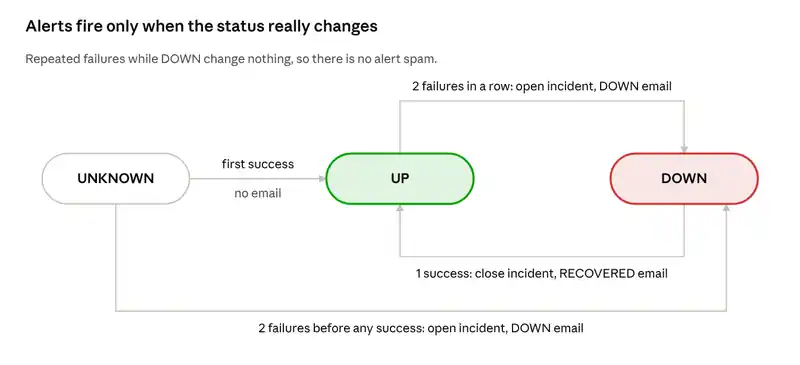
Every email comes from a transition into a new state, never from a single check, which is what keeps alerts quiet and trustworthy.
Why an event instead of calling the mail sender directly?#
Three real production bugs are avoided this way:
- Email for a change that never happened.
@TransactionalEventListener(AFTER_COMMIT)sends only after the database commit succeeds. - A slow SMTP server blocking checks.
@Asyncsends on another (virtual) thread. - A broken mail server breaking monitoring. Mail errors are caught and logged; checks keep running.
Step 1: Incident repository and service#
package com.upcheck.incident;

import org.springframework.data.domain.Page;
import org.springframework.data.domain.Pageable;
import org.springframework.data.jpa.repository.JpaRepository;

import java.util.Optional;

public interface IncidentRepository extends JpaRepository<Incident, Long> {

    Optional<Incident> findFirstByMonitorIdAndResolvedAtIsNullOrderByStartedAtDesc(Long monitorId);

    Page<Incident> findByMonitorIdOrderByStartedAtDesc(Long monitorId, Pageable pageable);
}
Propagation.MANDATORY makes these methods fail loudly if someone calls them outside a transaction, because opening an incident without saving the status change would leave the data inconsistent.
package com.upcheck.incident;

import com.upcheck.monitor.Monitor;
import org.springframework.stereotype.Service;
import org.springframework.transaction.annotation.Propagation;
import org.springframework.transaction.annotation.Transactional;

import java.time.Instant;
import java.util.Optional;

@Service
public class IncidentService {

    private final IncidentRepository incidentRepository;

    public IncidentService(IncidentRepository incidentRepository) {
        this.incidentRepository = incidentRepository;
    }

    /** Opens a new incident unless one is already open (idempotent). */
    @Transactional(propagation = Propagation.MANDATORY)
    public Incident open(Monitor monitor, Instant at, String cause) {
        return incidentRepository.findFirstByMonitorIdAndResolvedAtIsNullOrderByStartedAtDesc(monitor.getId())
                .orElseGet(() -> incidentRepository.save(new Incident(monitor, at, cause)));
    }

    /** Closes the open incident, if any, and returns it. */
    @Transactional(propagation = Propagation.MANDATORY)
    public Optional<Incident> resolve(Monitor monitor, Instant at) {
        Optional<Incident> open =
                incidentRepository.findFirstByMonitorIdAndResolvedAtIsNullOrderByStartedAtDesc(monitor.getId());
        open.ifPresent(incident -> incident.resolve(at));
        return open;
    }
}
Step 2: The event and the alert listener#
The event carries plain values, not entities. By the time the async listener runs, the transaction is closed and a lazy monitor.getOwner() would throw LazyInitializationException.
package com.upcheck.alert;

import com.upcheck.monitor.MonitorStatus;

import java.time.Duration;
import java.time.Instant;

public record MonitorStatusChangedEvent(
        Long monitorId,
        String monitorName,
        String url,
        String ownerEmail,
        String ownerName,
        MonitorStatus newStatus,
        String cause,
        Duration downtime,
        Instant at
) {}
package com.upcheck.alert;

import com.upcheck.config.AppProperties;
import com.upcheck.monitor.MonitorStatus;
import org.slf4j.Logger;
import org.slf4j.LoggerFactory;
import org.springframework.mail.MailException;
import org.springframework.mail.SimpleMailMessage;
import org.springframework.mail.javamail.JavaMailSender;
import org.springframework.scheduling.annotation.Async;
import org.springframework.stereotype.Service;
import org.springframework.transaction.event.TransactionPhase;
import org.springframework.transaction.event.TransactionalEventListener;

import java.time.Duration;
import java.time.ZoneOffset;
import java.time.format.DateTimeFormatter;

@Service
public class AlertService {

    private static final Logger log = LoggerFactory.getLogger(AlertService.class);
    private static final DateTimeFormatter TIME =
            DateTimeFormatter.ofPattern("yyyy-MM-dd HH:mm:ss 'UTC'").withZone(ZoneOffset.UTC);

    private final JavaMailSender mailSender;
    private final String from;

    public AlertService(JavaMailSender mailSender, AppProperties props) {
        this.mailSender = mailSender;
        this.from = props.mail().from();
    }

    @Async
    @TransactionalEventListener(phase = TransactionPhase.AFTER_COMMIT)
    public void onStatusChanged(MonitorStatusChangedEvent event) {
        SimpleMailMessage mail = new SimpleMailMessage();
        mail.setFrom(from);
        mail.setTo(event.ownerEmail());

        if (event.newStatus() == MonitorStatus.DOWN) {
            mail.setSubject("[DOWN] " + event.monitorName() + " is not responding");
            mail.setText("""
                    Hi %s,

                    UpCheck detected that your monitor is DOWN.

                    Monitor: %s
                    URL:     %s
                    Reason:  %s
                    Since:   %s

                    We will email you again when it recovers.
                    — UpCheck
                    """.formatted(event.ownerName(), event.monitorName(), event.url(),
                    event.cause(), TIME.format(event.at())));
        } else {
            mail.setSubject("[RECOVERED] " + event.monitorName() + " is back up");
            mail.setText("""
                    Hi %s,

                    Good news: your monitor is UP again.

                    Monitor:  %s
                    URL:      %s
                    Downtime: %s
                    Back at:  %s

                    — UpCheck
                    """.formatted(event.ownerName(), event.monitorName(), event.url(),
                    humanize(event.downtime()), TIME.format(event.at())));
        }

        try {
            mailSender.send(mail);
            log.info("Sent {} alert for monitor {}", event.newStatus(), event.monitorId());
        } catch (MailException e) {
            // an email failure must never break monitoring; log and move on
            log.error("Could not send {} alert for monitor {}", event.newStatus(), event.monitorId(), e);
        }
    }

    static String humanize(Duration d) {
        if (d == null) return "unknown";
        long h = d.toHours(), m = d.toMinutesPart(), s = d.toSecondsPart();
        if (h > 0) return h + "h " + m + "m";
        if (m > 0) return m + "m " + s + "s";
        return s + "s";
    }
}
Step 3: Final version of CheckService#
Replace the Part 5 CheckService with this one. It opens and closes incidents and publishes the event. The history() method is used by the API in Part 7.
package com.upcheck.check;

import com.upcheck.alert.MonitorStatusChangedEvent;
import com.upcheck.common.PageResponse;
import com.upcheck.config.AppProperties;
import com.upcheck.incident.IncidentService;
import com.upcheck.monitor.Monitor;
import com.upcheck.monitor.MonitorRepository;
import com.upcheck.monitor.MonitorService;
import com.upcheck.monitor.MonitorStatus;
import org.slf4j.Logger;
import org.slf4j.LoggerFactory;
import org.springframework.context.ApplicationEventPublisher;
import org.springframework.data.domain.Pageable;
import org.springframework.stereotype.Service;
import org.springframework.transaction.annotation.Transactional;

import java.time.Duration;
import java.time.Instant;

@Service
public class CheckService {

    private static final Logger log = LoggerFactory.getLogger(CheckService.class);

    private final MonitorRepository monitorRepository;
    private final CheckResultRepository checkResultRepository;
    private final IncidentService incidentService;
    private final MonitorService monitorService;
    private final ApplicationEventPublisher events;
    private final int failureThreshold;

    public CheckService(MonitorRepository monitorRepository, CheckResultRepository checkResultRepository,
                        IncidentService incidentService, MonitorService monitorService,
                        ApplicationEventPublisher events, AppProperties props) {
        this.monitorRepository = monitorRepository;
        this.checkResultRepository = checkResultRepository;
        this.incidentService = incidentService;
        this.monitorService = monitorService;
        this.events = events;
        this.failureThreshold = props.checker().failureThreshold();
    }

    @Transactional
    public void record(Long monitorId, CheckOutcome outcome) {
        Monitor monitor = monitorRepository.findById(monitorId).orElse(null);
        if (monitor == null || !monitor.isActive()) {
            return;
        }

        checkResultRepository.save(new CheckResult(monitor, outcome));

        MonitorStatus previous = monitor.getStatus();
        MonitorStatus changedTo = monitor.recordCheck(outcome.up(), outcome.checkedAt(), failureThreshold);

        if (changedTo == MonitorStatus.DOWN) {
            incidentService.open(monitor, outcome.checkedAt(), outcome.errorMessage());
            log.warn("Monitor {} is DOWN: {}", monitorId, outcome.errorMessage());
            publish(monitor, MonitorStatus.DOWN, outcome.errorMessage(), null, outcome.checkedAt());

        } else if (changedTo == MonitorStatus.UP && previous == MonitorStatus.DOWN) {
            Duration downtime = incidentService.resolve(monitor, outcome.checkedAt())
                    .map(i -> i.duration(outcome.checkedAt()))
                    .orElse(null);
            log.info("Monitor {} RECOVERED after {}", monitorId, downtime);
            publish(monitor, MonitorStatus.UP, null, downtime, outcome.checkedAt());
        }
        // UNKNOWN -> UP is the first successful check: nothing to alert
    }

    @Transactional(readOnly = true)
    public PageResponse<CheckResponse> history(Long userId, Long monitorId, Pageable pageable) {
        monitorService.findOwned(userId, monitorId);
        return PageResponse.from(checkResultRepository
                .findByMonitorIdOrderByCheckedAtDesc(monitorId, pageable)
                .map(CheckResponse::from));
    }

    private void publish(Monitor m, MonitorStatus status, String cause, Duration downtime, Instant at) {
        events.publishEvent(new MonitorStatusChangedEvent(
                m.getId(), m.getName(), m.getUrl(),
                m.getOwner().getEmail(), m.getOwner().getName(),
                status, cause, downtime, at));
    }

    public record CheckResponse(Instant checkedAt, boolean up, Integer statusCode,
                                Long responseTimeMs, String errorMessage) {
        static CheckResponse from(CheckResult r) {
            return new CheckResponse(r.getCheckedAt(), r.isUp(), r.getStatusCode(),
                    r.getResponseTimeMs(), r.getErrorMessage());
        }
    }
}
Add a monitor for https://httpstat.us/503 with a 1-minute interval. After two checks, open Mailpit at http://localhost:8025: the [DOWN] email is there, and the incidents table has an open row. Change the URL to a working site and wait for the [RECOVERED] email.
Key takeaways#
- Alert on status transitions, not on single checks, so users never get spammed.
- Send email AFTER_COMMIT so a rolled-back change never triggers an alert.
- Run listeners with @Async and catch mail errors so SMTP problems never stop monitoring.