Frontend vs Backend Development: Which One Should You Choose in 2026?
Frontend vs backend explained: what each developer does, skills, roadmaps, salaries in India in 2026, and how to build a portfolio and apply for your first job.
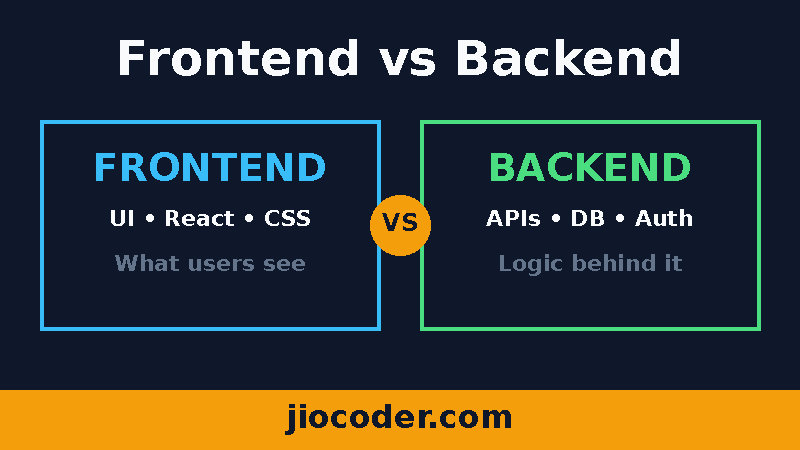
Every new web developer hits the same question sooner or later: should I become a frontend developer or a backend developer? This guide answers it properly — what each role does, the skills, salaries in India, how to start, and how to actually land the job.
What is frontend development?#
Frontend (client side) is everything the user sees and interacts with in the browser or app: layouts, buttons, forms, animations, product pages, dashboards. If you open Amazon and click “Add to cart”, the button, the cart drawer that slides in and the updated count are all frontend.
A frontend developer turns designs (usually from Figma) into fast, accessible, responsive interfaces and connects them to APIs.
What a frontend developer does day to day#
- Builds UI components and pages from designs
- Makes the site work on mobile, tablet and desktop
- Calls APIs and shows the data (loading, error and empty states)
- Manages app state (cart, user login, filters)
- Improves performance: Core Web Vitals, image optimisation, lazy loading
- Handles accessibility, SEO basics and analytics/tracking (GTM, events)
What is backend development?#
Backend (server side) is the part the user never sees: servers, databases, business logic, authentication and APIs. When you click “Place order”, the backend checks stock, charges the payment, saves the order in the database and sends the confirmation email.
What a backend developer does day to day#
- Designs and builds REST or GraphQL APIs
- Designs database schemas and writes efficient queries
- Handles authentication and authorisation (JWT, OAuth, sessions)
- Integrates payment gateways, email, SMS and third-party services
- Writes background jobs, queues and caching (Redis)
- Deploys and monitors services (Docker, CI/CD, cloud, logs)
Think of a restaurant. The frontend is the dining area, menu and waiter — what the customer experiences. The backend is the kitchen, storeroom and billing system — what makes it all work.
Frontend vs backend: side-by-side comparison#
| Point | Frontend | Backend |
|---|---|---|
| Focus | User interface and experience | Data, logic, servers and security |
| Core languages | HTML, CSS, JavaScript, TypeScript | Java, Python, JavaScript (Node.js), Go, C#, PHP |
| Popular frameworks | React, Next.js, Angular, Vue, Tailwind | Spring Boot, Express/NestJS, Django, FastAPI, .NET |
| Databases | Rarely directly (localStorage, IndexedDB) | PostgreSQL, MySQL, MongoDB, Redis |
| Feedback loop | Instant and visual — you see changes in the browser | Less visual — tests, logs and API responses |
| Main challenges | Browser quirks, responsive design, performance, state | Scale, data consistency, security, system design |
| Good fit if you like | Design, visuals, user behaviour | Logic, data, problem-solving, architecture |
| Interview focus | JavaScript deep dive, React, machine coding, frontend system design | DSA, databases, APIs, concurrency, backend system design |
Why choose frontend?#
- Visible results: you see what you build immediately — very motivating for beginners.
- Easy start: you only need a browser and an editor to begin.
- Huge demand: every company with a website or app needs UI developers — e-commerce, SaaS, agencies, startups.
- Freelancing friendly: landing pages, Shopify stores and portfolio sites are easy to sell.
Downsides: the ecosystem changes fast, and many people think frontend is “just HTML and CSS” — but strong frontend engineering (performance, architecture, accessibility) is genuinely hard.
Why choose backend?#
- Deep problem-solving: data modelling, scaling and security are intellectually rich.
- Stable fundamentals: databases, HTTP and system design change slower than UI frameworks.
- Slight pay edge: on average backend roles pay a little more, especially at senior levels.
- Path to architecture, DevOps and cloud roles.
Downsides: less visual feedback, a steeper start (servers, databases, deployment), and on-call duty is common.
What about full stack?#
A full stack developer works on both sides. Startups love full stack developers because one person can ship a complete feature. But most strong full stack developers started by going deep on one side first. Our advice: pick one, become job-ready, then expand.
Salary: how much do frontend and backend developers earn in India?#
Salary depends far more on company type and skill level than on frontend vs backend. Rough 2026 ranges in India:
| Level | Frontend (approx.) | Backend (approx.) |
|---|---|---|
| Fresher – service company | ₹3.5 – 8 LPA | ₹4 – 10 LPA |
| Fresher – mid product / startup | ₹8 – 15 LPA | ₹10 – 18 LPA |
| Fresher – top product / FAANG | ₹18 – 30 LPA | ₹22 – 38 LPA |
| 2–3 years | ₹8 – 20 LPA (top firms much higher) | ₹10 – 22 LPA (top firms much higher) |
| Senior (5–8+ years) | ₹20 – 60 LPA+ | ₹25 – 70 LPA+ |
These are CTC figures and vary by city (Bengaluru, Hyderabad, Gurugram and Pune usually pay more). Always check the fixed vs variable split — read our post on the CTC illusion before accepting any offer.
The gap between frontend and backend is small at good companies. A strong frontend engineer at a product company earns far more than an average backend developer at a service company.
How to start: frontend roadmap#
- HTML: semantic tags, forms, accessibility basics. (1–2 weeks)
- CSS: box model, Flexbox, Grid, responsive design, media queries. (3–4 weeks)
- JavaScript: variables, functions, arrays/objects, DOM, events,
fetch, promises,async/await, closures, the event loop. (6–8 weeks — the most important step) - Git and GitHub: commits, branches, pull requests.
- React: components, props, state, hooks (
useState,useEffect), routing, forms. - Tailwind CSS or another styling approach.
- TypeScript basics.
- Next.js: routing, server rendering, SEO.
- State and data: Redux Toolkit or Zustand, React Query.
- Performance, testing and deployment: Lighthouse, Jest/React Testing Library, deploy on Vercel or Netlify.
How to start: backend roadmap#
- One language, properly: Java, Python or JavaScript (Node.js). Pick one.
- How the web works: HTTP methods, status codes, headers, cookies, DNS.
- A framework: Spring Boot (Java), Express/NestJS (Node), or Django/FastAPI (Python).
- Databases: SQL first (PostgreSQL or MySQL) — joins, indexes, transactions. Then MongoDB.
- REST API design: CRUD, validation, pagination, error handling.
- Authentication: hashing passwords, JWT, role-based access.
- Caching and queues: Redis, background jobs.
- Testing: unit and integration tests.
- Docker and deployment: containers, CI/CD, a cloud like AWS or Render.
- System design basics: load balancing, scaling, rate limiting.
Follow our step-by-step Spring Boot Uptime Monitor series — it covers APIs, JPA, email alerts, testing, Docker and deployment.
Common to both: DSA and fundamentals#
Most product companies test Data Structures and Algorithms for both frontend and backend roles. Spend around an hour a day on arrays, strings, hashing, two pointers, recursion, trees and basic graphs. Check our 11-week Frontend + DSA interview roadmap for a daily plan.
Projects that get you hired#
Frontend project ideas#
- E-commerce store with product listing, filters, cart and checkout UI (use a fake API)
- Admin dashboard with charts, tables, search and pagination
- Movie or weather app with API integration, loading and error states
- A personal portfolio site — fast, responsive and accessible
Backend project ideas#
- Authentication service with sign-up, login, JWT and roles
- URL shortener with analytics and Redis caching
- Uptime monitor or job scheduler with email alerts
- E-commerce API: products, cart, orders, payments (test mode)
Two or three polished, deployed projects with a clean README beat ten half-finished tutorial clones.
How to apply for frontend or backend jobs#
1. Build your resume#
- One page, simple format that ATS can read (no heavy graphics).
- Sections: summary, skills, experience/internships, projects, education.
- Write impact, not duties: “Reduced page load time by 35% using lazy loading” beats “Worked on performance”.
- Add live links and GitHub links for every project.
- Tailor keywords to each job description (React, Next.js, Spring Boot, SQL…).
2. Set up your online presence#
- LinkedIn: clear headline (“Frontend Developer | React, Next.js, TypeScript”), turn on “Open to work” for recruiters, post about what you build.
- GitHub: pinned repositories, good READMEs, regular commits.
- Portfolio website with your projects and contact details.
3. Where to apply#
- Job portals: LinkedIn Jobs, Naukri, Indeed, Instahyre, Wellfound (startups), Cutshort, Internshala (internships and fresher roles).
- Company career pages: apply directly to companies you admire.
- Referrals: the strongest channel. Message engineers at the company politely with your resume and the job link.
- Off-campus drives and hackathons for freshers.
“Hi [Name], I’m a frontend developer with [X] experience in React and Next.js. I saw the [Role] opening at [Company] (job link). I’ve built [one relevant project]. Would you be open to referring me? My resume is attached. Thanks a lot!”
4. Apply smartly#
- Apply to 5–10 relevant jobs a day consistently rather than 100 in one day.
- Apply within the first few days of a posting.
- Keep a simple tracker: company, role, date, status, follow-up.
- Follow up after a week if you hear nothing.
5. Prepare for interviews#
| Round | Frontend | Backend |
|---|---|---|
| Online test | JS output questions, DSA | DSA, SQL queries |
| Technical 1 | JS concepts: closures, promises, event loop, this, debounce | Language core, OOP, collections, multithreading |
| Technical 2 | Machine coding: build a component in React in 60–90 mins | Build/design an API, database design |
| System design | Design a news feed UI, autocomplete, image carousel | Design a URL shortener, rate limiter, chat system |
| HR / managerial | Projects, teamwork, conflicts, salary expectations | |
6. Negotiate the offer#
Research the market range, ask for the fixed and variable split in writing, compare notice period and benefits, and negotiate politely. Having a second offer is the strongest leverage.
So, which one should you choose?#
- Choose frontend if you enjoy design, like seeing visual results quickly and care about user experience.
- Choose backend if you enjoy logic, data and building systems that scale.
- Still unsure? Build one small project on each side — a React to-do app and a simple Node/Express API. The one you enjoy debugging at 11 PM is your answer.
Whatever you pick, go deep, build real projects and stay consistent. Both paths lead to great careers — and to full stack, if you want it later.
Key takeaways#
- Frontend builds what users see; backend builds the logic, data and APIs behind it.
- Backend pays slightly more on average, but company tier and skill matter far more.
- Pick one side, follow a roadmap, and build 2–3 deployed projects.
- DSA and fundamentals matter for both at product companies.
- Apply consistently, use referrals, track applications and prepare for each interview round.