The CTC Illusion: How Bonus Promises Inflate Your Salary
Why a big CTC on your offer letter often hides bonuses that never get paid, the tricks companies use, and how to protect yourself before you sign.
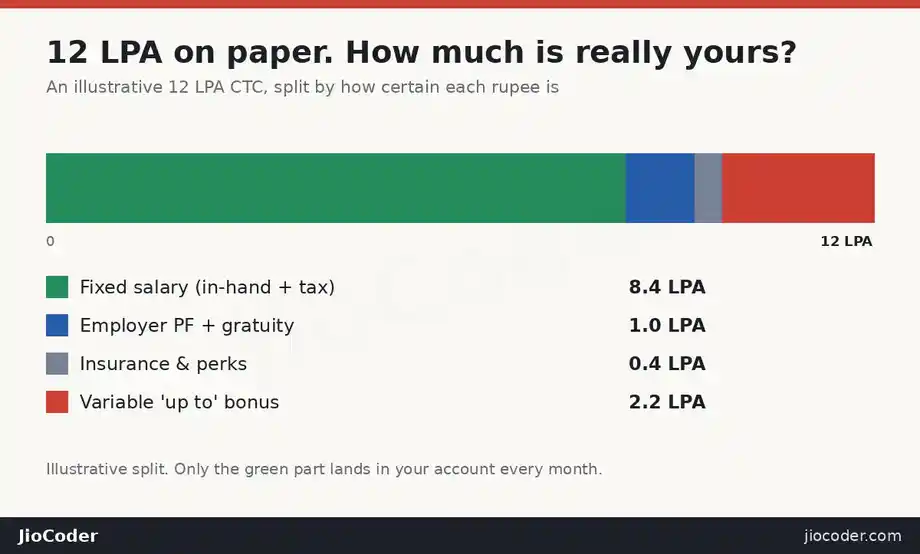
You accept a job at "12 LPA CTC" and celebrate. Then the first payslip arrives, and the monthly credit looks closer to a 9 LPA job. A year later, the "performance bonus" that made up a big slice of that CTC is quietly cut, delayed, or never paid at all.
This is one of the most common complaints among salaried professionals in India. CTC (Cost to Company) was meant to show the total an employer spends on you. In practice, many companies use it as a marketing number, padded with bonuses and benefits that look generous on paper but are designed to be hard to collect.
How a CTC is built, and where the bonus hides#
A typical CTC bundles very different kinds of money together. Only some of it ever reaches your bank account each month.
| Component | Paid monthly? | Guaranteed? |
|---|---|---|
| Basic, HRA, special allowance | Yes | Yes |
| Employer PF contribution | No, goes to your PF account | Yes |
| Gratuity | No, only after about 5 years of service | Conditional |
| Health and group insurance premium | No, paid to the insurer | Yes |
| Variable pay / performance bonus | No, yearly or quarterly | No |
| Joining or retention bonus | No, often with clawback terms | Conditional |
| ESOPs, meal cards, "one-time" perks | Rarely | Rarely |
The last few rows are where the inflation happens. A company can add 15 to 30 percent to the headline CTC with variable pay and conditional bonuses, while your fixed, guaranteed salary stays modest.
The bonus tricks employees keep running into#
Not every unpaid bonus is a scam. But some patterns show up so often that they look less like bad luck and more like design.
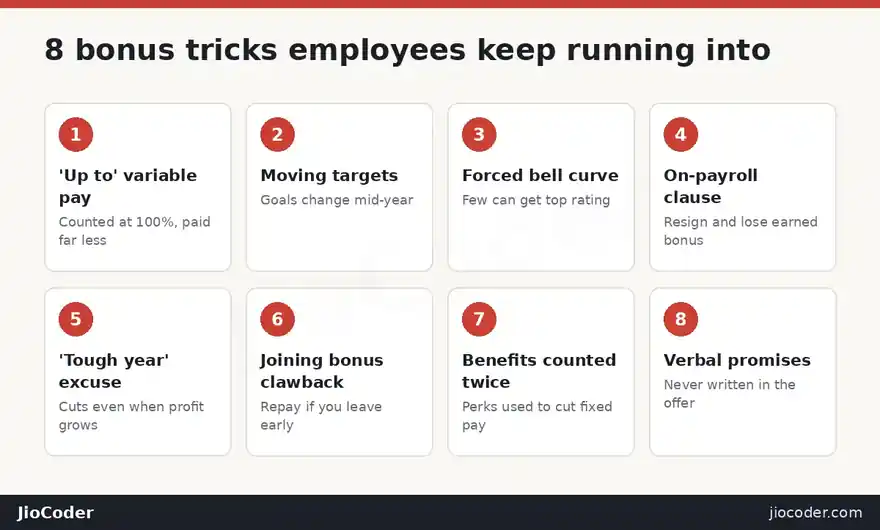
- "Up to" variable pay. The offer says variable pay of up to 2 LPA. The CTC counts the full 2 LPA. In reality, payout depends on company, team and individual ratings, and 100 percent is almost never achieved.
- Moving targets. Bonus goals are set vaguely or changed mid-year. When appraisal time comes, the target was "not met."
- Forced rating curves. Bell-curve appraisals mean only a small share of people can get the top rating, no matter how well the whole team performed.
- "Must be on payroll" clauses. The bonus is paid months after the year ends, and only to people still employed on the payout date. Resign in between and you lose a year's bonus you already earned.
- Company performance as an escape hatch. "The business had a tough year" becomes a reason to cut everyone's bonus, even when revenue or profit has grown.
- Clawbacks on joining bonuses. A joining bonus is counted in first-year CTC, but you must repay it, sometimes in full, if you leave within 12 to 24 months.
- Benefits counted twice. Insurance, gratuity and even office meals are added into CTC, then used to justify a low fixed salary.
- Verbal promises. "You'll definitely get your full bonus" is said in the interview but never written into the offer letter.
Why management does it#
The incentives are simple. A bigger CTC wins candidates away from competitors, while a smaller fixed salary keeps actual costs low.
- Hiring headlines. Recruiters and job portals compare CTC, so an inflated figure attracts better candidates.
- Cheaper appraisals. Hikes are calculated on fixed pay. Keeping fixed pay low keeps every future raise small too.
- Retention through fear. A delayed bonus makes people stay "just until payout," year after year.
- Low cost of breaking promises. Most employees won't challenge an unpaid bonus. They're worried about references, their relieving letter, or simply don't know their rights.
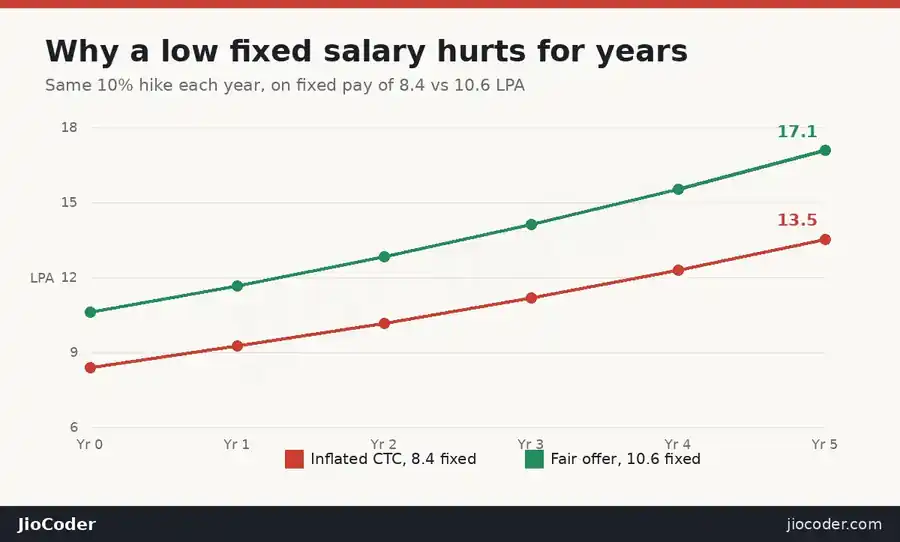
The chart above shows why this matters long after you join. With the same 10 percent hike every year, starting on 8.4 LPA fixed instead of 10.6 LPA leaves you about 3.6 LPA a year behind by year five.
None of this is unique to one company. It reflects a management culture that treats the offer letter as a sales pitch rather than a contract.
How to protect yourself before you sign#
The best time to fight a bonus scam is before you join. Use this checklist on every offer.
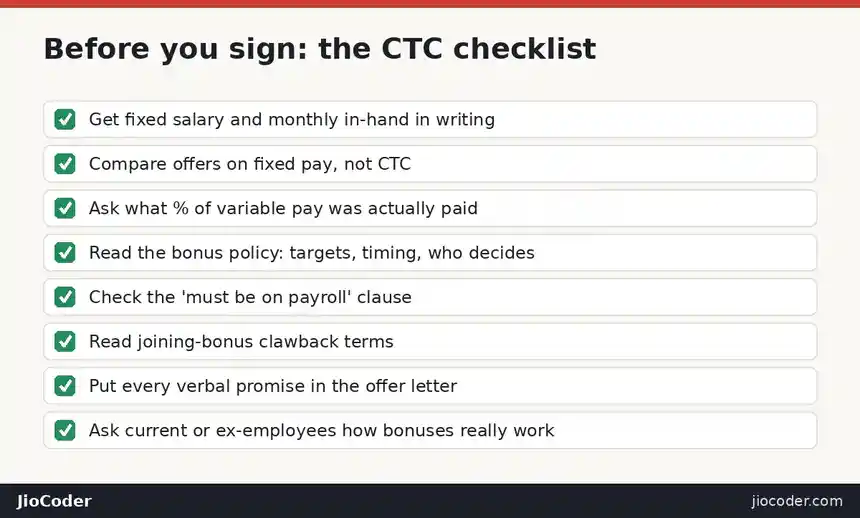
- Ask for the fixed annual salary and the monthly in-hand amount in writing, separately from CTC.
- Compare offers on fixed pay, not CTC.
- Ask what percentage of variable pay was actually paid out to your role in the last two or three years.
- Get the bonus policy document: who decides, what the targets are, and when it is paid.
- Check whether you must be on payroll on the payout date to receive it.
- Read clawback terms on joining and retention bonuses: amount, period and whether repayment is pro-rated.
- Make sure anything promised verbally appears in the offer letter.
- Ask current or former employees on professional networks how bonuses really work there.
If your bonus is withheld#
If a bonus that was promised in writing is denied without a clear reason, you have options. Move step by step and keep a paper trail.
- Collect evidence. Save your offer letter, bonus policy, appraisal ratings, target emails and any messages about the payout.
- Ask HR in writing. Request the exact calculation of your bonus and the reason for any cut. Keep it polite and factual.
- Escalate internally. Use the grievance or ethics channel if HR doesn't answer.
- Talk to colleagues. If many people faced the same cut, a collective written request is harder to ignore.
- Get outside advice. For large amounts, an employment lawyer or the local labour department can tell you whether the contract is enforceable. Statutory bonus rules in India apply only to certain salary bands, so performance bonuses usually depend on what your contract says.
- Share your experience responsibly. Honest, factual reviews on employer-review sites warn future candidates. Stick to what happened to you and avoid personal attacks.
This post is general information, not legal advice. Check your specific contract with a qualified professional.
Judge a job by what you can bank#
CTC is not a lie by itself, but it is easy to abuse. Companies with honest management state fixed pay clearly, publish their bonus rules, and pay what they promise.
So next time an offer shows a big CTC, ask one question first: how much of this is guaranteed? The answer tells you more about the company's management than any number on the letter.
Key takeaways#
- CTC mixes guaranteed pay with conditional bonuses; only fixed pay reliably reaches your account.
- "Up to" variable pay, payroll-date clauses and clawbacks are the most common ways bonuses disappear.
- A low fixed salary shrinks every future hike, so the gap grows each year.
- Get fixed pay, bonus rules and past payout rates in writing before you sign.