Types of Networks: PAN, LAN, MAN, WAN and More
Learn the differences between PAN, LAN, MAN and WAN networks, plus WLAN, SAN, VPN and SD-WAN, with real-world examples and technologies for each.
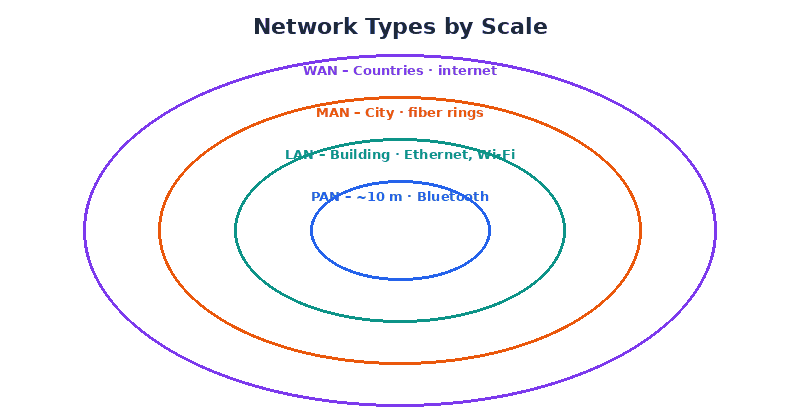
Networks are usually classified by the geographic area they cover. Each size uses different technologies, has different owners and comes with different speed and cost trade-offs.
Networks by scale#
PAN – Personal Area Network#
A PAN connects devices around a single person, typically within about 10 metres. Your phone talking to earbuds, a smartwatch or a car's infotainment system forms a PAN.
- Technologies: Bluetooth, USB, NFC, Zigbee.
- Owner: the individual.
LAN – Local Area Network#
A LAN covers a home, office, school or building. It's privately owned, fast and low-latency.
- Technologies: Ethernet (1–100 Gbps), Wi-Fi (WLAN).
- Typical devices: switches, access points, a router to reach the internet.
- Example: every laptop, printer and phone connected in your office.
MAN – Metropolitan Area Network#
A MAN spans a city or campus, linking multiple LANs. It's often run by a city, university or ISP.
- Technologies: metro Ethernet, fiber rings, sometimes fixed wireless.
- Example: a university connecting all its campus buildings, or a city's fiber backbone.
WAN – Wide Area Network#
A WAN covers large distances – across countries or continents. The internet is the largest WAN.
- Technologies: leased lines, MPLS, SD-WAN over broadband, submarine cables, satellite, 4G/5G.
- Owner: usually leased from telecom carriers; slower and costlier per Mbps than a LAN.
Comparison#
| Type | Range | Typical speed | Ownership |
|---|---|---|---|
| PAN | ~10 m | Kbps – Mbps | Personal |
| LAN | Building / campus | 1–100 Gbps | Private |
| MAN | City | 1–100 Gbps | Private / municipal / ISP |
| WAN | Country / global | Mbps – multi-Gbps | Carriers, leased |
How enterprises connect their sites#
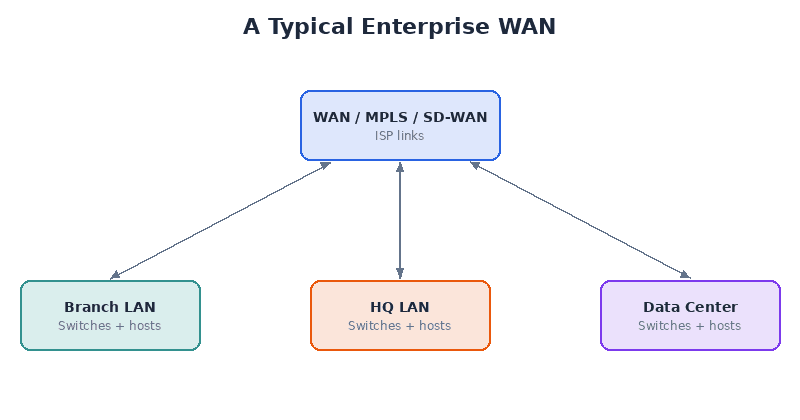
A company with many offices links each branch LAN, its headquarters and its data centers over a WAN:
- MPLS – a private carrier network with predictable performance, traditionally used for enterprise WANs.
- Site-to-site VPN – encrypted tunnels over the public internet, cheaper but less predictable.
- SD-WAN – software that combines several links (broadband, 5G, MPLS) and steers each application over the best one in real time.
Other network types you'll hear about#
- WLAN – a wireless LAN using Wi-Fi.
- CAN – Campus Area Network, between LAN and MAN in size.
- SAN – Storage Area Network, a dedicated high-speed network connecting servers to shared storage.
- VPN – a virtual private network built on top of another network.
- VPC – a Virtual Private Cloud, your isolated network inside AWS, Azure or GCP.
If latency between two of your services is suddenly high, check whether traffic that should stay on the LAN or within one cloud region is accidentally crossing a WAN link.
Key takeaways#
- PAN < LAN < MAN < WAN in geographic scale.
- LANs are private, fast and cheap; WANs are long-distance and usually leased.
- The internet is the biggest WAN of all.
- Enterprises link sites with MPLS, VPNs or SD-WAN.