Why Choose JioCoder Contests? Daily, Sunday and Live Coding Contests Explained
How JioCoder contests work — three daily challenges, Sunday rated contests and proctored live contests with prizes — and why they are a better habit for interview prep.
Most people prepare for coding interviews by bookmarking problems they never open again. Contests fix that: a timer, a fixed set of problems and a rank at the end push you to actually solve. This guide explains every JioCoder contest format, shows exactly how ranking is calculated with a worked example, and gives you a weekly plan that fits around a full-time job.
Three ways to compete#
JioCoder has three contest formats. Each one fixes a different problem in your prep: the daily challenge builds the habit, Sunday contests build speed under pressure, and live contests add real stakes.
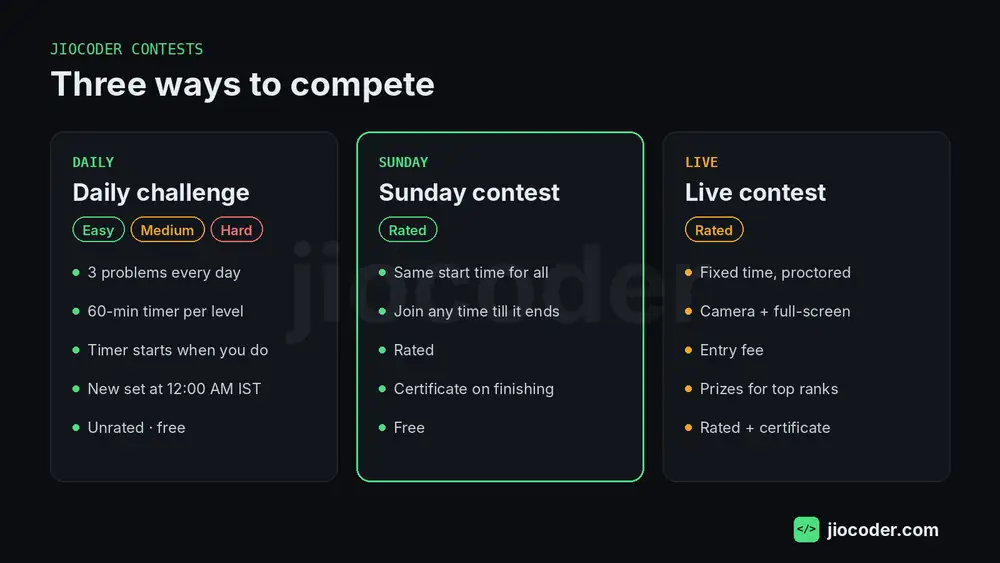
| Format | When | Timer | Rated | Cost | Best for |
|---|---|---|---|---|---|
| Daily challenge | Every day, new set at 12:00 AM IST | 60 minutes per level, starts when you press Start | No | Free | Building a daily habit |
| Sunday contest | Every Sunday, same start time for everyone | Fixed contest window | Yes | Free | Real contest pressure |
| Live contest | Fixed time, announced in advance | Fixed, proctored | Yes | Entry fee | Prizes and serious competition |
Daily challenge: easy, medium and hard#
Every day you get three problems, one at each level. You can pick just one or solve all three. The important detail is the timer: each level has its own 60-minute personal timer, and it only starts when you press Start.
In practice this means you can open the easy problem before work, the medium one at lunch and the hard one at night, and each attempt still gets a full, honest 60 minutes. A new set appears every night at 12:00 AM IST.
Sunday contests#
Sunday is where you test yourself against everyone else. All participants start at the same time, the contest is rated, and registration stays open until the contest ends. If you join late you can still play; you simply have less time on the clock.
This is the closest thing to a real online assessment round: same problems for everyone, same deadline, and a public rank at the end.
Live contests#
Live contests are proctored and run at a fixed time with an entry fee and prizes. Your camera and full-screen mode are required for the whole contest.
The proctoring is the point. When money is involved, the leaderboard only means something if everyone on it solved honestly, and camera plus full-screen checks protect the players who did.
How ranking works#
The scoring is short enough to remember and follows the same rules used in most standard coding contests. There are only four rules.
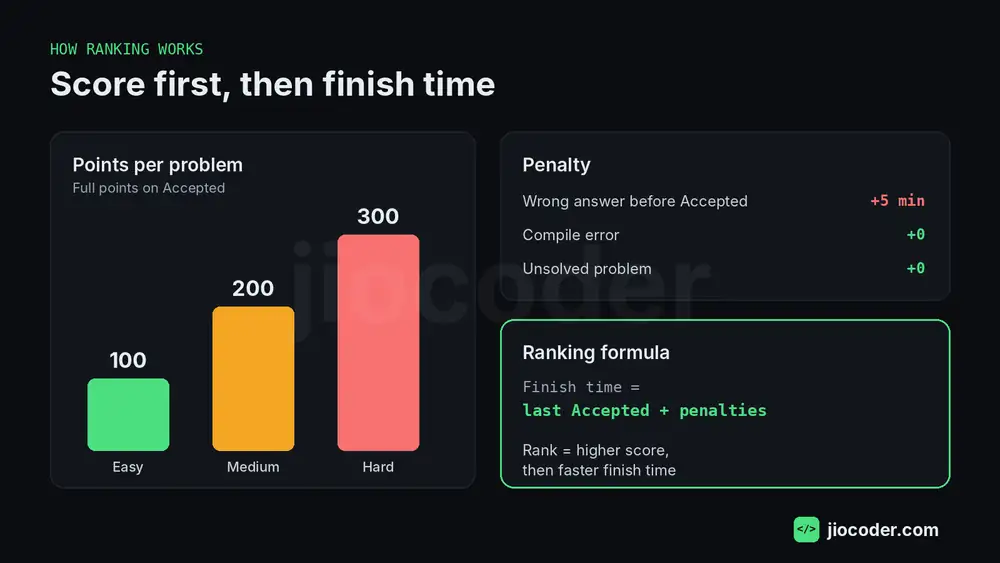
- Points per problem: Easy 100, Medium 200, Hard 300. You get the full points the moment a submission is Accepted. There is no partial credit for passing some test cases.
- Penalty: each wrong answer before Accepted on a problem adds 5 minutes. Compile errors add nothing, and a problem you never solve adds nothing either.
- Finish time: the time of your last Accepted submission, plus all your penalty minutes.
- Rank: the higher score always wins. Finish time is only used to break a tie between equal scores.
A worked example#
Rules make more sense with numbers. Here are three players in the same contest with one Easy, one Medium and one Hard problem.
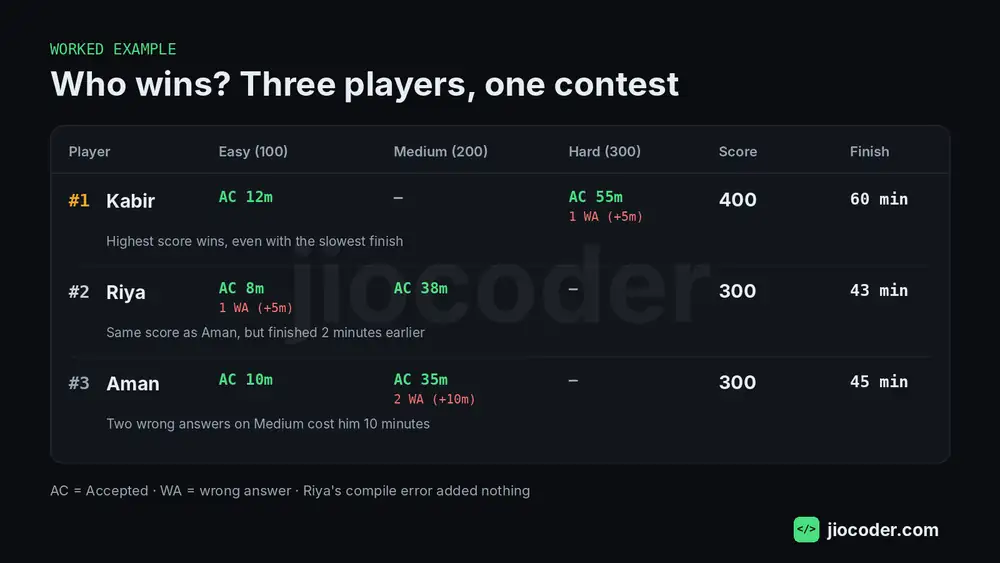
| Player | What happened | Score | Finish time | Rank |
|---|---|---|---|---|
| Kabir | Easy Accepted at 12 min. Skipped Medium. Hard Accepted at 55 min after 1 wrong answer. | 100 + 300 = 400 | 55 + 5 = 60 min | #1 |
| Riya | Easy Accepted at 8 min after 1 wrong answer. Medium Accepted at 38 min. One compile error along the way. | 100 + 200 = 300 | 38 + 5 = 43 min | #2 |
| Aman | Easy Accepted at 10 min. Medium Accepted at 35 min after 2 wrong answers. | 100 + 200 = 300 | 35 + 10 = 45 min | #3 |
Three lessons come out of this table:
- Score beats speed. Kabir finished last on the clock (60 minutes) but still ranked first, because solving the Hard problem gave him 400 points and nobody else crossed 300.
- Penalties decide ties. Aman actually got his last Accepted earlier than Riya (35 vs 38 minutes). But his two wrong answers cost 10 minutes, pushing him to 45, so Riya's 43 wins.
- Compile errors are free. Riya's compile error added nothing. Only wrong answers on a problem you go on to solve cost time.
Because only wrong answers before Accepted cost time, run your own edge cases (empty input, a single element, duplicates, the largest values) before you press Submit. One careful submission beats three rushed ones.
Since a Hard problem is worth three Easy ones, it is usually worth attempting the Hard problem once the Easy is done, even if it takes longer. A higher score always ranks above a faster finish.
Why choose JioCoder contests?#
1. A schedule that fits a working developer#
Most contest platforms give you one fixed slot a week. Miss it, and you wait seven days. On JioCoder the daily timer is personal, so you can practise under real contest pressure on a weekday evening after office hours instead of waiting for Sunday.
2. You never really miss a contest#
Missed a Sunday? Every past contest can be taken as a virtual contest with the same problems and the same timer. It is unrated, but the experience is identical, which turns the archive into a free bank of timed mock rounds you can use whenever you have an hour.
3. A certificate for everyone who finishes#
Sunday and live contests are rated, and everyone who finishes gets a certificate, not just the top three. For students and freshers, that is visible proof of consistent practice you can add to LinkedIn or a resume.
4. A fair leaderboard when money is involved#
Paid contests only work if people trust the rankings. Proctored live contests with camera and full-screen checks protect the players who solve honestly, so a prize actually means something.
5. Contests connected to the rest of your prep#
Contests on JioCoder sit right next to the JioCoder 450 DSA roadmap, topic-wise practice, machine coding and mock interviews. Struggled with a graph problem on Sunday? The concept lesson and more practice problems for that exact topic are on the same site, so a bad contest turns straight into a study plan.
What stood out to us#
Looking at the contest system as a whole, three design decisions make it more than "just another leaderboard":
- Penalties only for wrong answers. Compile errors and unsolved problems add no time, so beginners are not scared away from submitting.
- Three levels every single day. A beginner gets an easy win, an intermediate developer gets a real medium, and the hard problem keeps strong coders coming back.
- Free and paid, side by side. Daily and Sunday contests cost nothing; live contests add prizes for people who want stakes. You choose how serious you want to be.
If we had to suggest one improvement for regulars, it would be making your streak and rating history easy to share, so a month of daily practice is visible outside the site too.
A weekly plan that fits a full-time job#
You do not need hours every day. About an hour on most days, with Sunday as the main event, is enough to see your rank climb within a month.
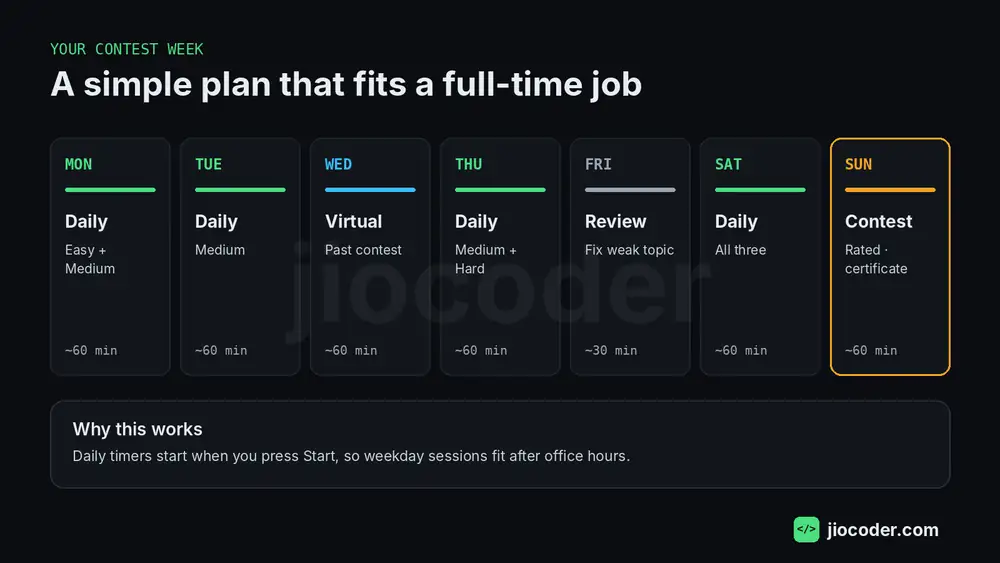
- Monday, Tuesday, Thursday, Saturday: the daily challenge. Start with Easy and Medium, and add Hard on days you have time.
- Wednesday: one past contest as a virtual contest, picked for a topic you are weak in.
- Friday: about 30 minutes reviewing the problems you got wrong this week, using the concept lessons.
- Sunday: the rated Sunday contest. Then note which topic cost you the most time and practise it next week.
How to start this week#
- Open jiocoder.com/contests and solve today's easy problem. It takes about 15 minutes.
- Register for this Sunday's contest. Registration stays open until it ends.
- After Sunday, take one past contest as a virtual contest to practise your weakest topic.
- When you feel ready, try a live contest for prizes.
Key takeaways#
- JioCoder runs daily challenges (easy, medium, hard), rated Sunday contests and proctored live contests with prizes.
- Scoring is Easy 100, Medium 200, Hard 300, with a 5-minute penalty only for wrong answers before Accepted.
- Rank is decided by score first; finish time (last Accepted plus penalties) only breaks ties.
- Daily timers start when you do, and past contests can be taken as virtual contests, so you never miss practice.
- Everyone who finishes a Sunday or live contest gets a certificate.