Kadane's Algorithm: Maximum Subarray Sum in O(n) Explained
Learn Kadane's algorithm for the maximum subarray problem: brute force to O(n), step-by-step trace, all-negative arrays, returning indices, maximum product subarray, circular subarrays and the dynamic programming idea behind it.
The maximum subarray problem asks: given an array of integers, which contiguous subarray has the largest sum? For [-2, 1, -3, 4, -1, 2, 1, -5, 4] the answer is [4, -1, 2, 1] with sum 6. Kadane's algorithm solves it in a single pass with O(1) extra memory, and it's one of the best introductions to dynamic programming.
From brute force to O(n)#
Brute force: O(n²)#
def max_subarray_brute(nums):
    best = float("-inf")
    for i in range(len(nums)):
        total = 0
        for j in range(i, len(nums)):
            total += nums[j]          # sum of nums[i..j]
            best = max(best, total)
    return best
This checks every subarray. For 100,000 elements that's about 5 billion additions: far too slow.
The key insight#
At each index, the best subarray ending here either:
- extends the best subarray ending at the previous index, or
- starts fresh at this element.
If the running sum so far is negative, it can only drag the total down, so you drop it and start over.
current[i] = max(nums[i], current[i-1] + nums[i])
best       = max(best, current[i])
Kadane's algorithm#
def max_subarray(nums: list[int]) -> int:
    current = best = nums[0]
    for x in nums[1:]:
        current = max(x, current + x)   # extend or restart
        best = max(best, current)
    return best

print(max_subarray([-2, 1, -3, 4, -1, 2, 1, -5, 4])) # 6public int maxSubArray(int[] nums) {
int current = nums[0], best = nums[0];
for (int i = 1; i < nums.length; i++) {
current = Math.max(nums[i], current + nums[i]);
best = Math.max(best, current);
}
return best;
}function maxSubArray(nums) {
let current = nums[0], best = nums[0];
for (let i = 1; i < nums.length; i++) {
current = Math.max(nums[i], current + nums[i]);
best = Math.max(best, current);
}
return best;
}Step-by-step trace#
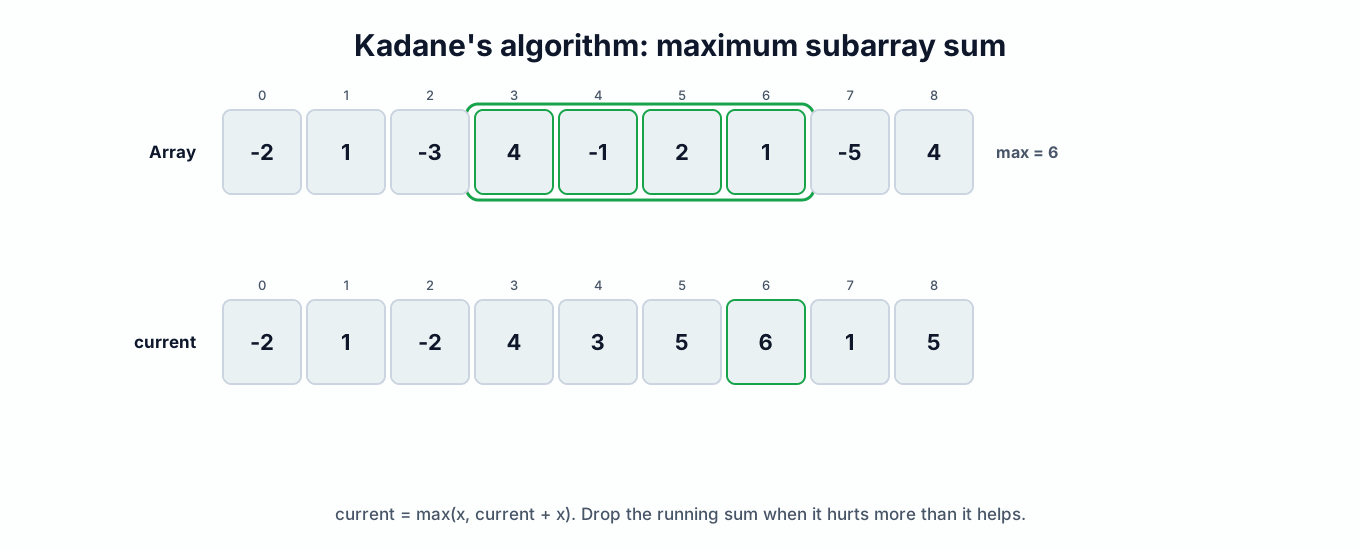
| i | nums[i] | current = max(x, current + x) | best |
|---|---|---|---|
| 0 | -2 | -2 | -2 |
| 1 | 1 | max(1, -1) = 1 (restart) | 1 |
| 2 | -3 | max(-3, -2) = -2 | 1 |
| 3 | 4 | max(4, 2) = 4 (restart) | 4 |
| 4 | -1 | max(-1, 3) = 3 | 4 |
| 5 | 2 | max(2, 5) = 5 | 5 |
| 6 | 1 | max(1, 6) = 6 | 6 |
| 7 | -5 | max(-5, 1) = 1 | 6 |
| 8 | 4 | max(4, 5) = 5 | 6 |
Handling all-negative arrays#
A popular "simplified" version resets current to 0 whenever it goes negative:
current = best = 0
for x in nums:
    current = max(0, current + x)
    best = max(best, current)
# returns 0 for [-3, -1, -2] ← wrong if the subarray must be non-emptyIf the subarray must contain at least one element, the answer for [-3, -1, -2] is -1. Initialise both variables with nums[0], as in the main version above, and this case works automatically.
Returning the subarray itself#
def max_subarray_with_indices(nums):
    best = current = nums[0]
    start = best_start = best_end = 0
    for i in range(1, len(nums)):
        if nums[i] > current + nums[i]:
            current = nums[i]
            start = i                     # a new subarray begins here
        else:
            current += nums[i]
        if current > best:
            best, best_start, best_end = current, start, i
    return best, nums[best_start:best_end + 1]

print(max_subarray_with_indices([-2, 1, -3, 4, -1, 2, 1, -5, 4]))
# (6, [4, -1, 2, 1])
Why it's dynamic programming#
Define dp[i] = the maximum sum of a subarray that ends at index i. Then:
dp[0] = nums[0]
dp[i] = max(nums[i], dp[i-1] + nums[i])
answer = max(dp)
Since each dp[i] only depends on dp[i-1], you don't need the whole array: a single variable is enough. That optimisation is exactly Kadane's algorithm, and recognising "only the previous state matters" is a pattern you'll reuse in many DP problems.
Complexity#
| Approach | Time | Space |
|---|---|---|
| Brute force | O(n²) | O(1) |
| Divide and conquer | O(n log n) | O(log n) |
| Kadane's | O(n) | O(1) |
Variation 1: maximum product subarray#
With multiplication, a negative number can turn the smallest product into the largest. Track both the max and min ending here:
def max_product(nums):
    cur_max = cur_min = best = nums[0]
    for x in nums[1:]:
        if x < 0:
            cur_max, cur_min = cur_min, cur_max   # a negative flips them
        cur_max = max(x, cur_max * x)
        cur_min = min(x, cur_min * x)
        best = max(best, cur_max)
    return best

print(max_product([2, 3, -2, 4]))     # 6
print(max_product([-2, 3, -4]))       # 24
Variation 2: maximum circular subarray#
If the array wraps around, the best subarray is either a normal one (Kadane) or one that wraps, which equals total − (minimum subarray):
def max_subarray_circular(nums):
    total = sum(nums)
    cur_max = best_max = cur_min = best_min = nums[0]
    for x in nums[1:]:
        cur_max = max(x, cur_max + x)
        best_max = max(best_max, cur_max)
        cur_min = min(x, cur_min + x)
        best_min = min(best_min, cur_min)
    if best_max < 0:
        return best_max                 # all negative: wrapping would mean an empty subarray
    return max(best_max, total - best_min)

print(max_subarray_circular([5, -3, 5]))   # 10 (5 + 5, wrapping)
Variation 3: best time to buy and sell stock#
Maximum profit from one buy and one sell is Kadane's algorithm on the daily price differences:
def max_profit(prices):
    best = current = 0
    for i in range(1, len(prices)):
        current = max(0, current + prices[i] - prices[i - 1])
        best = max(best, current)
    return best

print(max_profit([7, 1, 5, 3, 6, 4]))   # 5 (buy at 1, sell at 6)
Here an empty choice (no trade, profit 0) is allowed, so the reset-to-0 version is correct.
Both scan contiguous ranges, but the sliding window technique needs a condition that only gets "worse" as the window grows. Kadane's works with negative numbers because it decides at each step whether the past helps or hurts.
Practice problems#
- Maximum Subarray (LeetCode 53)
- Maximum Product Subarray (152)
- Maximum Sum Circular Subarray (918)
- Best Time to Buy and Sell Stock (121)
- Maximum Absolute Sum of Any Subarray (1749)
- Max Sum of Rectangle No Larger Than K (363), applying Kadane's to 2D
Review complexity analysis in Big O notation explained.
Key takeaways#
- At each index, either extend the previous subarray or start fresh:
current = max(x, current + x). - Kadane's algorithm runs in O(n) time and O(1) space.
- Initialise with
nums[0]so all-negative arrays return the largest element. - It's dynamic programming where only the previous state is needed.
- Track both max and min for products, and use
total − min subarrayfor circular arrays.